

Where they live
Black grouse need a complex mosaic of different habitats. They prefer:
- open mature pinewoods
- heather moorland
- young conifer woodland
They’re often found on the fringes of upland heather moors and native woodland.
What they eat
Adults graze on:
- shoots and buds of larch, birch and heather
- hawthorn, rowan and blaeberries
Young chicks feed on insects.
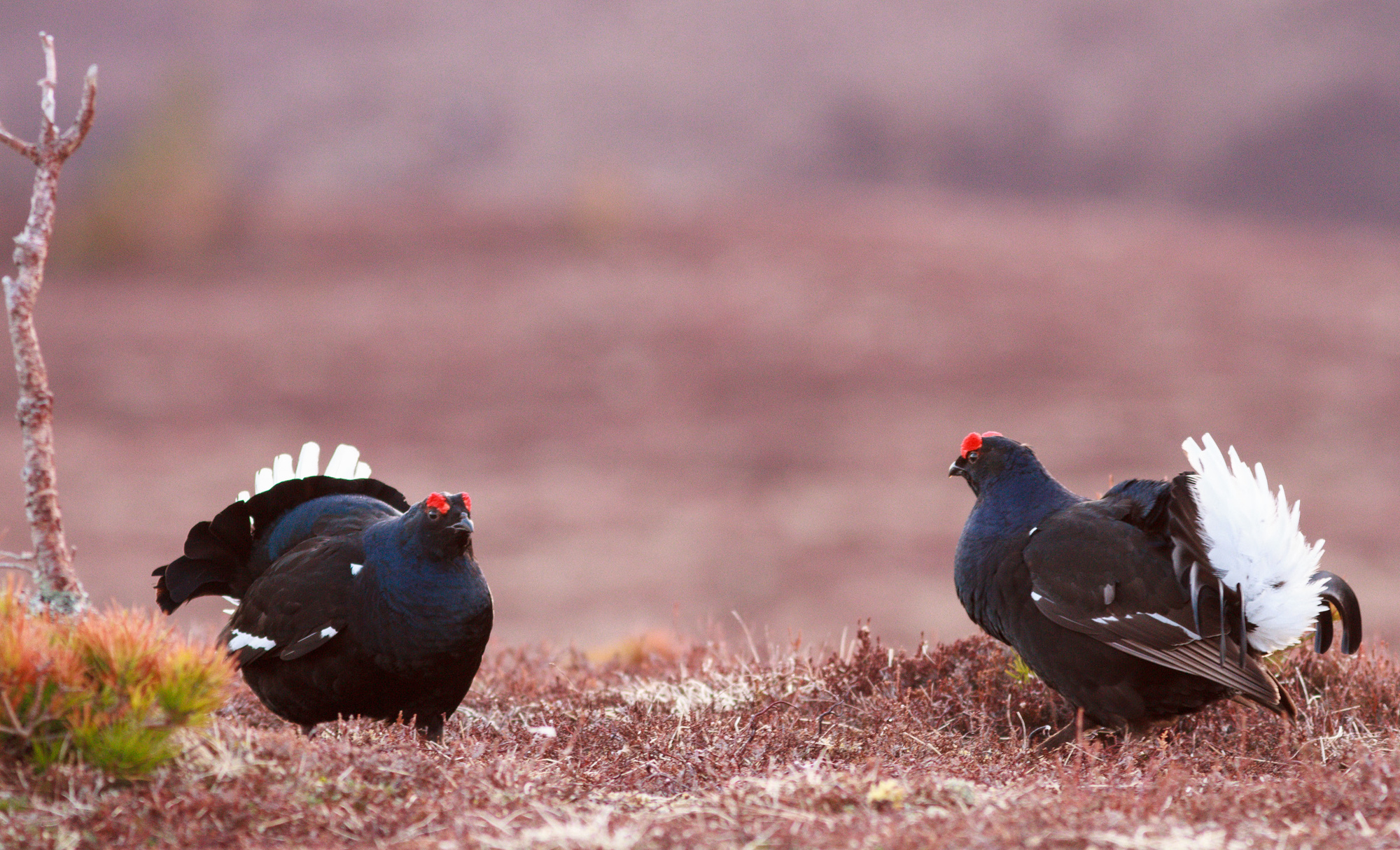
Lek season
Leks are traditional display sites. Here, the males strut, posture and fight in front of the females. With their distinctive appearance and cry, the male black grouse is one of nature’s eye-catchers. During the lek, you'll often see their lyre-shaped tails raised in a fan of snow-white feathers.
Meanwhile the females, called a grey hen, quietly lays the eggs and raises the chicks. Her grey-brown feathers camouflaged in the heather.
How to see them in the wild
You might accidentally frighten black grouse and see them taking off in alarm with fast wingbeats. The white wing stripe is clearly visible in flight.
Where might you see them
You might see black grouse in:
- Glenmore Forest Park within the Cairngorms National Park
- Galloway Forest Park in the southwest
You could also see them in other upland areas across the country.
When can you see them
You can see them all year around. Please avoid looking for them from April till July. This is their nesting season.
What to look out for
They’re the same size as a domestic hen. Not to be confused with the capercaillie, which is 30% larger. The female is slightly smaller than the male.
Young birds are often killed when they fly into tall deer fences. We make our fences more visible with diagonal and upright batons, or coloured netting. If you see a marked fence there’s a good chance that black grouse and capercaillie may be nearby.
Please follow the code of conduct at all times.